Saturday, 6 February 2016

Haulin’ by Alex McInturf, 5th February 2016


My life has become “The Deadliest Catch”. This thought was surprisingly poignant in the wordless blur of pure instinct that took over my brain. I was staring out at a scene mirroring the Discovery Channel television show that mesmerized me back before I truly understood what it meant to be hauling lines in massive waves and torrential rain that seemed quite intent on teaming up to sink our research vessel. Of course, I was being dramatic – relatively speaking, the open Alaskan seas experience far worse conditions than I could even imagine. I almost chuckled to myself at the comparison, but was immediately thrown into a seated position by an unexpected wave, effectively ending any romanticized view of the present reality. Small as they may be, two-meter swells are significant when your boat is only twenty-feet long and your personnel expects to be operating in relatively calm Bahamian waters. We don’t often endure fieldwork in such poor weather, as the winds eliminate sufficient water visibility. Then again, I’m not quite sure we anticipating what would happen this morning.  
            My alarm went off at around 06:00, and after filling a quick mug with tea (the prospect of tea time, in retrospect, seems laughable), we left the dock at 06:30 sharp for a longline haul at the aptly-named Tiger Grounds. I’ve been spoiled thus far in my time here. The last time we set the lines in this area, we caught a total of 13 tiger sharks, one of which was a massive pregnant female with a 3.7-meter total length. February wasn’t treating us quite as well, unfortunately, as we had only found two small tigers in twenty-four hours. We weren’t expecting much better during this final check, and indeed ultimately found only one small juvenile, barely one-meter long. We performed our standard work-up as the sun rose in a sky that was an appalling shade of red, a fact I pointed out to fellow volunteer Jo: “Red sky in the morning, sailors take warning!” I joked as I put on my sunglasses to see through the glare into the water. All humor aside, we couldn’t quite ignore the massive wall of grey behind us, a series of very distinguishable rolling clouds. As we began to haul in the first longline, the scene was threateningly beautiful – a blood-orange sunrise splitting the sky with the contrasting storm, the water glowing turquoise underneath. Perhaps due to our naïve faith in the weather forecast, we weren’t quite as efficient as we probably should have been as we leisurely pulled and coiled, chatting and joking, ironically enough, about the weather; joking, that is, until it hit. 
            We felt the first raindrops as we began the second line haul. “Alright, guys, let’s try to pick up the urgency a little bit,” instructed Chris, our skipper. As the lab’s resident “longline guy”, Matt reached to take the lead on the line. Then the first raindrops struck our faces. Rain wasn’t an issue, and because we scientists like to picture ourselves the very embodiment of toughness in the face of such adversity, we pressed on. As if to mock our lack of respect, the wind escalated from two to twenty knots in approximately thirty seconds, and the light rain became a sheer force of sleet. The white caps began slamming into our hull, washing over the bow and threatening to knock us off of our feet as we simultaneously tried to re-establish the laws of gravity in the waves that lifted our boat. Chatter transformed quickly to commands and urgent calls as we painstakingly made our way through the second line. With the last buoy pulled onboard, a call came through the static of the radio: “Hey, longline crew. We are just taking a look at the forecast here at the lab….” We didn’t even let it finish before we started laughing. We didn’t need a forecast – we were living it. And we still had three more longlines to go. 
            The next two hours were a hard lesson on the role of focus in seafaring; focus on balance using all necessary parts of the body, focus on coiling ever quicker, focus on bailing and bilging and balancing to prevent our boat from sinking. By the time we hauled in our last line, we were thoroughly soaked, battered, and bruised, and personally, I was fairly certain I had pulled a hamstring. What’s more, we were also vision-impaired - the clouds blocked our view of the island, and the rain attacked our eyes with such vigor that I was convinced Chris would go blind as he tried to search for the impossibly small channel markers that lined our route home. It wasn’t until we arrived in the shelter of our back bay that the characteristic humor of the Shark Lab began to re-emerge as the chill of wind and rain sunk into our bodies. Teeth chattering, Matt commented dryly: “This is one of those hauls that make you happy to just get home…glad we didn’t die.” And as the rest of the lab, considerably less haggard-looking, arrived on the dock to unload our water-logged gear, we whooped in celebration of our survival. 

Friday, 29 January 2016

"When in Rome, do as the Romans." by Maria Paz Gutierrez - January 29th 2016


                        "When in Rome, do as the Romans."

My Experience as a Volunteer in the Sharklab


Somebody once told me that proverbs reflect the way people of that culture think about the world.  A well-known proverb  of English-speaking cultures is "When in Rome, do as the Romans",  meaning that you have to act in the same way as the people around you.

For me, a foreign girl coming from Chile (a tiny third-world country) to the Famous Sharklab, inhabited by people coming from first-world countries (U.S.A, France, Australia, Canada and England), understanding and practice this proverb has been very useful.

Seeing a rice maker and a drone for the first time and watching BBC documentaries with actors that were in the Lab only hours before at first took me out of my comfort zone. This was heightened by the fact that I am still learning how to speak English, so I really didn´t understand anything about the house rules, duty list, packing practices , etc. The good thing is that any time that I made a mess, I would just say "I do not speak English."

Now that I have been here for 24 days, I am almost one Roman more, almost reaching a first-world understanding.... thinking about the postgraduate program in which I will enroll in two more years, the model and price of  the GPS that I will deploy with acoustic tag receivers to find sharks easily, or maybe even getting my own drone to find them without getting out of the boat.

Only a few weeks have passed and I have learned a lot more than what I was expecting, not only in a "fun-shark-work" way, but in a "do-and-fix-everything-that-you-will-need-to-do-the-fun-shark-work" way, from making a shark pen (see Alex McInturf blog: "When life gives you lemons...take DNA) and fixing gillnets to tagging tigers sharks and swimming with hammerhead sharks. This is a once-in-a-lifetime great opportunity with genius Romans, living, imitating and trying to understand them. What a great experience!


The Sharklab at dusk.


Sunday, 24 January 2016

'Home Economics with the Shark Lab' by Alex McInturf - January 24th

Home Economics with the Shark Lab


When referring to the act of sewing, most have a very classic cultural image in mind: perhaps cross-stitch, needlepoint, or maybe weaving a tapestry on a loom. Thanks to my most recent experience here at the Sharklab, it is unlikely that my definition will match that of general society for a quite a long time after my return to civilization. A few days ago, staff member Anthony handed me, not a needle and thread, but a broken stick and spool of rope as we stood on the beach, confronted by a stretch of green mesh thirty-seven meters long. Upon closer inspection, my team of volunteers and I could tell that years of use had taken their toll – the mesh was spotted with tears and gaping holes of all sizes, held together by spare pieces of old line and the occasional zip tie. As the sun sporadically peaked through a layer of clouds, we learned that our task for the afternoon was to completely dissemble the patches, removing any remaining ties or lines. From there, we were to move on to our ultimate goal: a new shark pen.
            As the first hours passed, we bent over with intense concentration, our fingers fumbling with knots and clipping with reckless abandon. Thirty-seven meters, however, began to stretch longer and longer, the knots more and more complex, as the sun began to set and the mosquitoes attacked our vulnerable ankles. By the end of the day, we saw before us now two pieces of mesh, each riddled with holes that seemed even larger. In the waning light, with the smell of dinner wafting from the Lab across the road, Anthony then taught us to sew, overlapping the two pieces lengthwise and securing them with an alternating loop and knot pattern. By the time the dinner bell rang, our loom barely had its first strands.
            For the next several days, the rain and wind continued a concerted effort to impede our work, but for Sharklab personnel, weather is not a worthy adversary. As the drops fell on our faces we transported our mesh to the yard, sewing morning and afternoon. Those who chose to stand felt the soreness of hamstrings too long stretched, while those seated on boat cushions were forced into the occasional head roll to relieve the growing stiffness in the upper back. Amidst laughing chatter and soft music, the minutes and hours blended into days, and the mesh began to sport bright white lining around newly repaired patches. The sewing continued until evening, four days after we had begun. I tied my last bowline and took my last stroll down what I had begun to consider my very own pen mesh, bending down and testing for strength in the line as I went. By the time I rose, satisfied, I had essentially forgotten the purpose behind the sewing; that is, until I heard the plan for the next day. It was time to build the pen.
            Under most normal circumstances, experienced pen builders can complete the task in a morning or afternoon. “Normal circumstances,” however, were too much to hope for in this case. Naturally, I was assigned to the pen-building crew, presumably because this had become my adopted project. We were directed by the fearless Chris Bolte, who seemed to know what he was doing, though after a mishap with rebar placement, we began to assail him for his questionable leadership. The mocking continued, bouncing between volunteers and Chris alike, heightening as the sun tried to warm the chilly air of the late morning. By lunchtime, we had only assembled half the pen mesh. Our afternoon was even busier, and somehow more filled with testosterone-fueled jokes. By the time we settled into a rhythm and finished tightening the security around the net, we were joined by three more volunteers, some of whom began the process of moving the baby lemon sharks and newly acquired ray from the old pen to the new. From the new pen location in the shallows, we could hear singing and laughter as paddleboards were loaded with cinder blocks, rebar, and tuna clips, floating alongside tubs of animals in the transition. The sun was sinking on our fifth day by the time we shed our wetsuits and ran inside for coffee, tea, and a hot dinner. Before we left, however, I stood in the new pen for a few minutes. As the water settled, I looked down. Two of the three baby lemons were snaking around my ankles. One had a small dark spot on its head. The ray would occasionally smack its wing on the surface of the water along the interior mesh, as if admiring our handiwork. Much as one might admire a sewn pillow, a knitted scarf, or a woven rug, I can’t imagine any better feeling than knowing that I have created a home, one that serves as a classroom as much as a refuge.


Image of a shark pen © Charlotte Sams

Tuesday, 12 January 2016

"Here comes the….rain?" by Alex McInturf - 12th January 2016


“My jacket is wet.” “My SHOES are wet!” “It is well and truly coming down out there.”
 These three phrases almost completely summarize my first week at the Bimini Shark Lab. Words without context, however, can be misleading. I’m surrounded by the usual morning bustle that characterizes rainy days here at the station – there are volunteers half-clad in wetsuits, prepared to depart at any moment, staff members staring at radars to determine when there will be a break in the weather, and a few pitbulls wrestling over a chew toy in the hallway. It has been ten days since my arrival, and I have yet to have an “off day.” Weekends truly don’t exist here; in fact, I can barely keep track of the time, much less the day, and dates only have meaning at the top of our data sheets. I arrived at the lab with the onset of the New Year with three new volunteers, just in time to work tirelessly with the rest of the crew (10 staff members, and 6 veteran volunteers) on a project that will provide critical data on the shark species that populate these waters.

 A few years ago, the lab deployed fifty acoustic receivers that collectively cover every marine area around both North and South Bimini. Twice a year since their initial establishment, they have been collected and then, following a massive data download, redeployed.  This is certainly no easy feat – each receiver cost roughly $1,300, and recollecting the installed units requires dropping a diver directly on top of the receiver’s exact coordinates. Then, of course, said diver must cope with factors entirely out of his or her control: visibility, current, or, as is the case today, unpredicted bouts of torrential downpour. Ideally the entire process takes place within 48 hours, but dark clouds rolled in during the early hours of this morning. Make no mistake, however, consideration for our personal comfort is not the cause for delay. In fact, I would argue that in addition to a collective passion for elasmobranchs, one of the major common characteristics embodied by every single person at this lab is a mildly insane willingness to sacrifice almost everything for the pursuit of knowledge. On the other hand, as researchers, we are nothing if not practical. We won’t be able to find the receivers in this weather.

Unfortunately, this research obstacle is fairly typical for this time of year. The cold fronts that hit the United States during the winter inevitably reach even the Bahamian islands, though they manifest themselves in slightly different ways. We fall victim to the weather’s capriciousness; already I’ve experienced the warmth of the sun on my back as we cruised across turquoise patches of water, only to don a sweatshirt in the overcast chill of the next morning. However, I have learned that these types of challenges unexpectedly bring out the very enthusiasm that defines the members of the Shark Lab. Our shoes may be wet, our jackets soaked, and our receivers left alone for the time being, but as we gradually disperse to find more weather-appropriate tasks, laughter and friendly chatter echo through our tiny home.    

Sharks and lasers By Chris Bolte, 8 December 2015

My field of vision, already limited by my mask, narrows further as I focus on my camera’s screen through its underwater housing. Having to concentrate so hard means that I am temporarily oblivious to my immediate surroundings, so I’m somewhat startled when I look up from my camera and gaze into the cold eyes of a 3.6-metre (12-foot) great hammerhead shark Sphyrna mokarran. It’s so close I can count its teeth.


Believe it or not, this is actually a pretty normal winter’s day with the Shark Lab in Bimini and it is a critical component of our great hammerhead research project. These personal encounters enable us to get close enough to photograph the sharks while projecting two parallel laser beams onto their bodies. The lasers, set 20 centimetres (eight inches) apart, can be used to estimate the total length of individual sharks, giving us valuable life-history information. This technique, called parallel laser photogrammetry, has emerged as a simple, non-invasive method to estimate with a fair degree of accuracy the sizes of large marine species such as manta rays, whale sharks and great white sharks – essentially, any animal that is difficult to capture safely.


In the water next to me, managing the bait-filled container used to attract the hammerheads, is my good friend and colleague Jack Massuger. As the vortex of sharks swirls around him, he remains composed, sifting through the blockade of stubborn nurse sharks to gently coerce the hammerheads into exposing their sides to my camera. If a shark’s side is anything but perpendicular to the twin green beams, it introduces an error of parallax. This means that, due to the angle between the photographer and the shark, the distance between the lasers will change, resulting in skewed length estimates. Getting perfect photos is a process that requires patience. We spend many dives and many hours with the hammerheads.
Using laser photogrammetry, paired with photo identification to distinguish between individuals, we are beginning to learn more about these enigmatic predators. How long are they spending in Bimini? Do they come back every year? Are these individuals sexually mature? Where were they before they came to Bimini, and where do they go when they leave?


After a season of data collection, we know that more females visit than males, and many of the sharks are large enough to be sexually mature. Using photo identification, along with acoustic receiver arrays, we have been able to locate sharks that we see in Bimini in places like Key Largo, Virginia and the Bahamas’ Exuma Islands, which has helped to reveal their large-scale movement patterns. Listed as Endangered by the IUCN, the great hammerhead faces strong fishing pressure for its distinct, scythe-like fins. Our goal is to learn as much as we can about the species so that we can use this information to protect individuals wherever they travel.


As dusk falls and the light begins to fade, the dive feels like a scene from a science-fiction horror movie. Sharks emerge from the darkness, continuing to circle around us. Two bright green laser beams slice through the water as we record a few more measurements, persisting until it’s too dim to continue. As our air dwindles, we take a final few rasping breaths through our regulators and slowly ascend. It is calm, oddly serene to have these sharks pass within centimetres of us, elegant in their slow, rhythmic swimming. As I shut down the lasers and pass my equipment up to the boat, I can’t resist looking down one last time. Hammerhead sharks pass beneath us and then, one by one, begin to disperse. These laser measurements are important for our research and conservation, but there is something else, something sublime, about just watching these sharks fade gently into the sanctuary of the dark, blue water.


Piece originally written for Save Our Seas Foundation and featured on their website here: http://saveourseas.com/update/sharks-and-lasers/
 

PIT for personality By Félicie Dhellemmes, 5 January 2016

When it comes to personality studies in sharks, the bigger the sample size, the better. In the third issue of Save Our Seas magazine, you might have read about how we study personality in juvenile lemon sharks at the Bimini Biological Field Station (also known as the Shark Lab). Now let me tell you about the PIT project, which catches enough sharks for us to conduct rigorous personality studies.
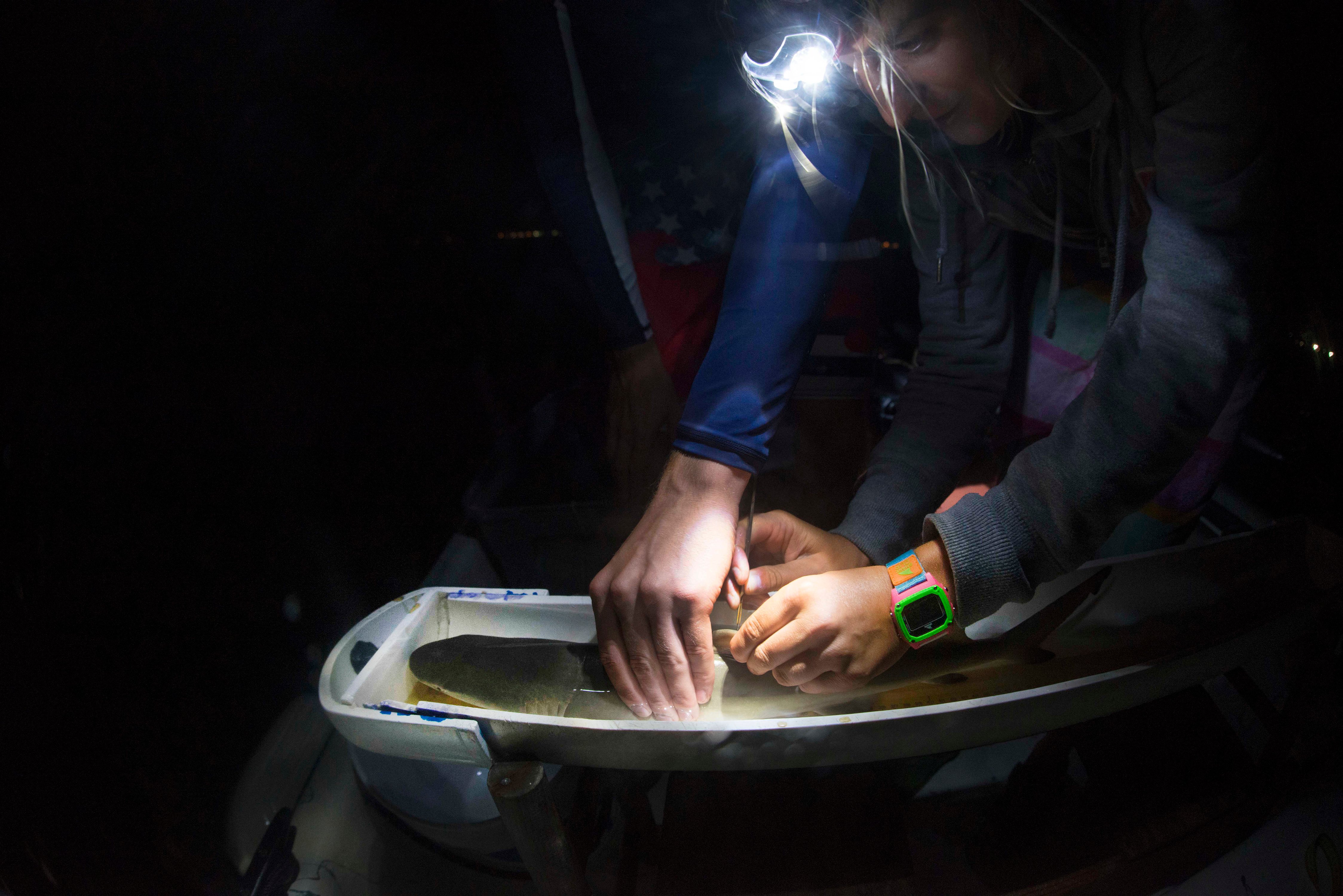
Mention the PIT project to a Shark Lab alumnus and you’ll probably hear words like crazy, exhausting, hilarious and miserable. The project is all of that! It involves capturing, in gill nets and at night, the entire population of juvenile lemon sharks of two nurseries in Bimini, measuring each shark and tagging it with a PIT (Passive Integrated Transmitter). By numbers, the PIT project is: three gill nets, four teams, 12 nights, hundreds of sharks and millions of mosquitoes. It’s been carried out each year since 1995 and has provided the Shark Lab with some major findings, such as the first evidence of female sharks returning to their place of birth.

PIT 2015 was my first round. So what goes through the head of a first-timer? In the weeks leading up to the first PIT night, the excitement builds slowly but surely – just like the pens that will hold all the captured sharks. Seasoned Shark Labbers tell their stories (sometimes funny, sometimes scary) to the newbies. All the equipment is checked, double-checked and checked again by anxious staff members. The closest grocery store is raided by dozens of interns worried about grumbling stomachs during the long nights.


Image © Charlotte Sams 2015

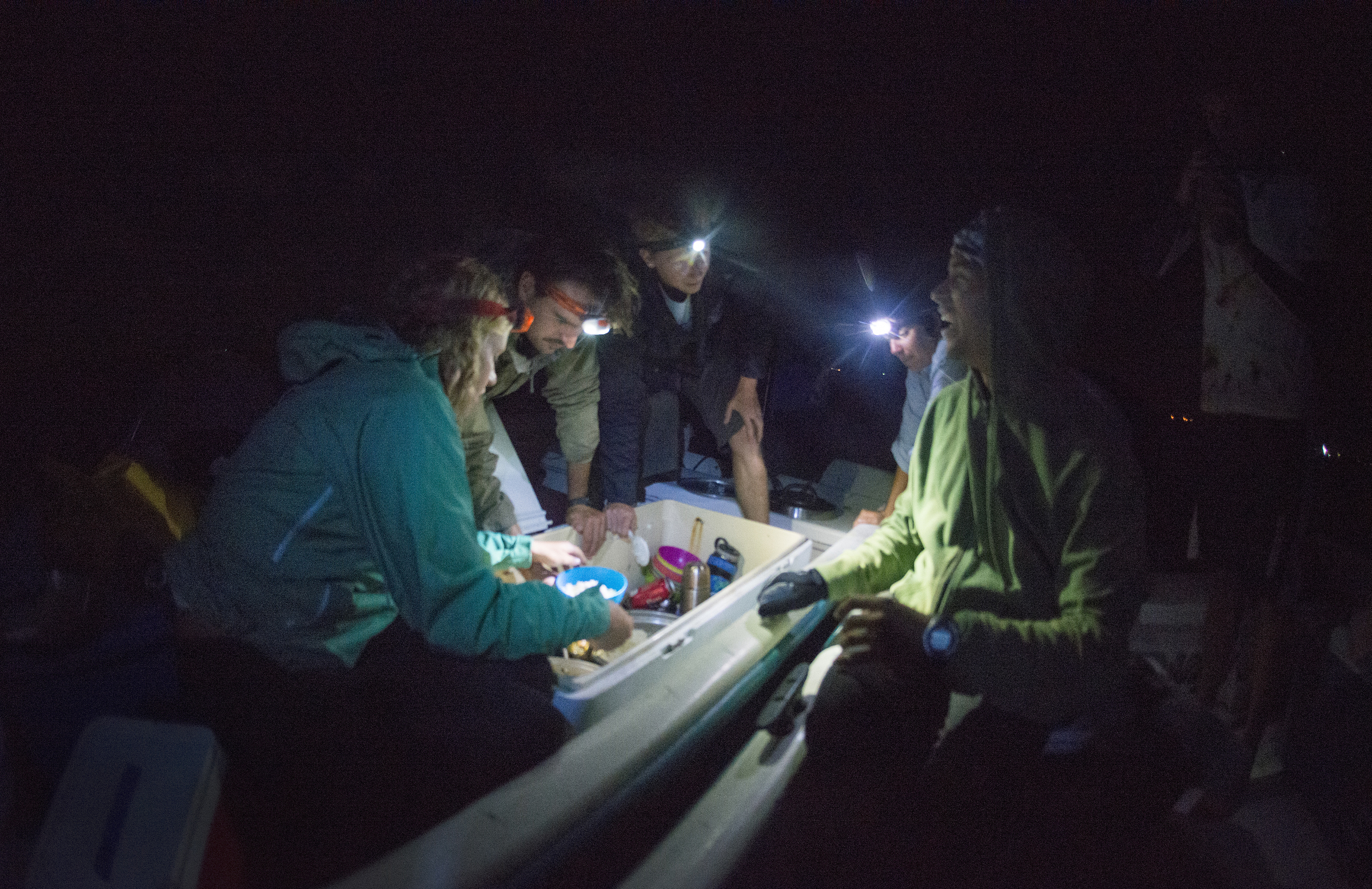
Then one day, finally, it’s time to go! The first set is done in a deliriously happy mood, teams betting on whose net will be the most successful (and whose will catch a smalltooth sawfish). Suddenly the first shark is captured, to resounding exclamations that can be heard in Miami. After a very busy first night, 15 wet-to-the-bones interns come home ecstatic about their adventure. But during the following nights grumpiness gradually replaces excitement. You need to be very positive to avoid being affected by the long, dark, cold hours, watching the number of sharks caught decrease each night, and the constant buzzing of bugs around you. Fortunately, the Shark Lab is a great group of friends. Every night hilarious games are played over the radio to keep everyone entertained and the home-crew dresses up to bring a delicious dinner that will warm hearts and bodies in the middle of the night.
After six long nights of fishing in one nursery, it is time for the PIT warriors to get a rest. A rest? Not really! All the nets need to be repaired, the equipment must be rechecked and everybody has to get ready for another six nights. The nights in the second nursery are similar to the previous ones, with the first being much busier than the rest. But this time everyone is ready, sleeping strategies are well established and all the crew are mentally prepared for the task ahead.


Image © Charlotte Sams 2015

In 2015 we tagged a total of 196 sharks, more than half of which were captured during the first night in each nursery. PIT 2015 involved 22 people, who finished the adventure exhausted but incredibly proud and excited. Did I tell you that sample size is important in personality studies? Well, during PIT 2015 60 sharks were tested for sociability and exploration, and a subset of 36 were tested for neophilia and boldness as well, providing me with a huge amount of data. So far, thanks to the PIT project, more than 250 sharks have been tested for personality traits. At the Shark Lab, this is how we roll!

Piece originally written for Save Our Seas Foundation & on their website: http://saveourseas.com/update/pit-for-personality/

A ray with a caveman’s weapon By Tristan Guttridge, 11 January 2016


Although it was eight years ago, I still remember my first encounter with a sawfish as one of the most extraordinary experiences of my life. And, in light of our recent paper ‘Occurrence and habitat use of the Critically Endangered small tooth sawfish, Pristis pectinata in the Bahamas’ being accepted by the Journal of Fish Biology, I feel it’s appropriate to recollect that moment now.

Grant Johnson (former sharklab manager) releasing the sawfish after capture. Photo by © Matthew Potenski.
 
Every summer in the months of May and June researchers at the Bimini Shark Lab set gill nets in North Bimini’s mangrove-fringed nursery areas to capture newborn and juvenile lemon sharks. The nets are anchored at the edge of the mangroves and pulled offshore, then set for 12 hours overnight and for six consecutive nights. The target species is the lemon shark, but every now and again something special makes an appearance.
Removing a lemon shark from a gillnet. Photo by © Charlotte Sams.
 
It was the first night of the North Bimini juvenile lemon shark tagging programme, 2007. I was leading a gill-net set on the western edge of the North Lagoon. The water was about one metre deep and the substrate was rocky with patches of sand. At about 11 pm, an hour or so past high tide, our team was on its usual 15-minute check, flashing the torch down the net as we putted alongside in our boat and viewed the water from the surface. Suddenly splash, struggle – a shark was tangled in the net, then another and a few metres later there was a bigger splash. Excitedly, within the space of 60 seconds all my team had launched themselves into the water to rescue our catch: two juvenile lemon sharks and a bonefish.
Shark tagging during annual tagging program. Photo by © Charlotte Sams.
 
Knowing that other sharks might be caught in the last two sections of the net, I reassured my team that I would collect them and the sharks on the way back and continued the check. I motored slowly along the length of the net, inspecting it carefully and methodically. As I got closer to the mangrove edge, I noticed that a large section – about 15 metres – of the net had turned into a huge cloud of silt. I couldn’t see a thing. My first thought was adult lemon shark (yippee) and then I considered big nurse shark (oh no – the net would be destroyed). The Shark Lab frequently documents both species in shallow water during summer, either pupping or seeking mates, so it was possible that one had got tangled up.
Smalltooth sawfish with tracking device. Photo by © Matthew Potenski.
 
 
The current gradually cleared the silt away and, to my absolute amazement, surprise and excitement, out of the murk appeared the instantly recognisable rostrum of a sawfish, with its evenly spaced teeth like a prehistoric caveman’s weapon. Ecstatic, I roared at the top of my voice, ‘Oh my god, it’s a sawfish, we’ve caught a sawfish.’ Then I shouted down the radio, ‘We’ve caught a sawfish, a sawfish, woohoo.’ Wilson, one of the volunteers, answered, ‘You’re joking!’ ‘Do I sound like I am joking?’ I gasped.
Smalltooth sawfish reflection. Photo by © Matthew Potenski.
 
Within quick succession, there were yelps of joy and cheers down the radio and across the sound! Any normal person would have thought we had won the lottery or that a boat full of pirates’ treasure had got caught in our net. To us, this was the lottery – one of the rarest, most imperilled creatures in the ocean and we had the privilege of seeing it up close!

A ray with a caveman’s weapon attached to its head… Photo by Matthew Potenski
 
 
Post originally written for Save our Seas Foundation and posted on their website here: http://saveourseas.com/update/a-ray-with-a-cavemans-weapon/