Monday, 12 March 2018

The rest is ancient history - By Ko Chuan Yang

The rest is ancient history.  
What first races through your mind when you're given the opportunity of a lifetime? Exhilaration, excitement, euphoria. Then anxiety, expectation and self-consciousness. As the emotions settled and the news came to bear and the initial ecstasy of acceptance ebbed all that was left was doubt of my self-worth and whether I'd be cut out for something like this. How was I supposed to use my BA Hons in HISTORY effectively at a shark research station? How'd I even land the gig? Spiralling into self-pity I miraculously managed to catch myself. My focus had been on my inadequacies but they had nothing to do with why I'd been selected to intern at the lab in the first place. People don't dole out opportunities like these carelessly and presumably they must've seen something in me that would be valuable to the Lab. I won't repeat to you the list of strengths I muttered to myself in that moment of reassurance as that would be ridiculously indulgent and I'd get ripped to shreds by the others here at the Lab. But if you are interested in my background check out my profile on the Shark Lab website *plug* or even my Instagram (@ko.away) *plugplugplug*.  The 35 hour journey from Singapore was an emotional rollercoaster climbing to wide grins and plunging to nail-biting nervousness.
Upon arriving I realized the needlessness of my worry. Sat around a set of plastic tables introducing themselves before dinner was one of the most diverse group of people I'd ever had the privilege to meet. Fishermen, project students, aspiring conservationists, photographers, researchers, aquarium mermaids, parasail operators and even a cook. Teamwork makes the dream work, I thought to myself a few days later, seeing how everyone had been picked and a group assembled that was so capable in so many different things and ways that we seldom found ourselves wanting. So then.. what would I like to say to you, dear reader, perhaps an aspiring volunteer or an avid fan of the work that is done here at the lab? I'd like to say that the Shark Lab, as amazingly unique a place as it is, demands all the same things from you as the regular workplace. Commitment, determination, respectfulness and adaptability. What sets it apart then, is that as I've practiced these values here at the lab, I've learnt more about not only shark research and fieldwork (which is pretty easy when you start at about 0) but also about myself than I have anywhere else before. The people working at the lab are inspirational in all senses of the word, from their infectious passion for the ocean to all their diverse strengths and admirable characters, they provide you with a bottomless pit of knowledge that you could plunge into and use to constantly better yourself.
Eight weeks ago I took a deep breath and dove in, and the rest is ancient history.

Happy volunteers after beautifully repainting the Sharklab!


Thursday, 7 December 2017

Oh, Those First Days... By Kinsey Matthews

“Are you going to survive here?” Chelle, our media manager and one of my new roommates, took in my puffy and swollen body with concerned eyes. Despite my hardest efforts, tears leaked out of the corner of my eyes. Fresh off the plane that landed moments ago on the small island of Bimini, I discovered I was allergic to mosquitos. The new volunteers, eager and looking for adventure, went for a stroll around the island. We were instantly swarmed by the tiny creatures. Cursing and swatting at our heads like madmen, we sprinted back to the lab. Our bodies were riddled with angry, itchy, red bumps. I counted over 50 bites on my face, shoulders, and legs. My reaction was particularly bad, so much so that one of the older volunteers referred to me as “the one with the bites” before they learned all of our names.

In all honesty, that question terrified me. Not just because I couldn’t imagine having this reaction to mosquitos every day, but because I had little to no experience with elasmobranchs. I had no idea what I was doing. What was a longline? What the heck does a BRUV mean? And why do all the volunteers groan when the staff mentions gillnet fixing? It was obvious the extent of my shark knowledge stopped at the end pages of a textbook.

One of our first activities as new volunteers was a reef shark dive. It was my first time swimming with sharks. Seeing them in their natural habitat, without layers of glass between myself and the sharks, was exhilarating. Our lab manager Ben threw chum into the water, and the once calm Caribbean reef sharks swam in an absolute frenzy. But instead of glass, the only object between us and the sharks was our flimsy looking fins. Adrenaline pumped through my veins. It was slightly terrifying, a little alarming, and utterly magical.

Caribbean Reef Shark (Carcharhinus perezii). Photo (C) Chelle Blais 

During our second week, we set out longlines. I snipped a fin clip from a juvenile tiger shark, attempted to insert a Casey Tag into an adult nurse shark (man those guys have thick skin), and stared with wide eyes as one of the assistant lab managers surgically implanted an acoustic tag into the abdomen of an adult female tiger shark. On our way back to the lab, with the sun setting and our clothes thrashing in the wind, all four of us whooped and hollered. We had just won the lottery.


A month and a half later I can say I’ve learned more during these past few weeks than I have during a few of my undergraduate courses. I can confidently work up a juvenile lemon shark, including taking fin clips for isotope and DNA analysis, body measurements such as length and girth, and sex ID. I know that gillnet fixing includes boiling in the hot sun, sweat dripping from every pore of your body as your fingers fumble to tie a double sheet bend knot. I’ve learned that watching BRUV’s (Baited Remote Underwater Video Stations) videos can be one of the most mundane tasks to one of the most thrilling as you watch a tiger shark rip bait out from a cage. Through trial and error, I now wear copious amounts of sunscreen, even on cloudy days. I’ve realized the importance of protective clothing and layers upon layers of DEET (pro tip: the “natural” stuff does NOT work) to ward off the dreaded blood sucking monsters we call mosquitos. Most of all, I’ve learned that I still know nothing. Whether it be how to decipher the acoustic pings of a tag implanted in a juvenile lemon shark during tracking, or the location of the snips that we use for gangion fixing, every day I’m discovering something new.

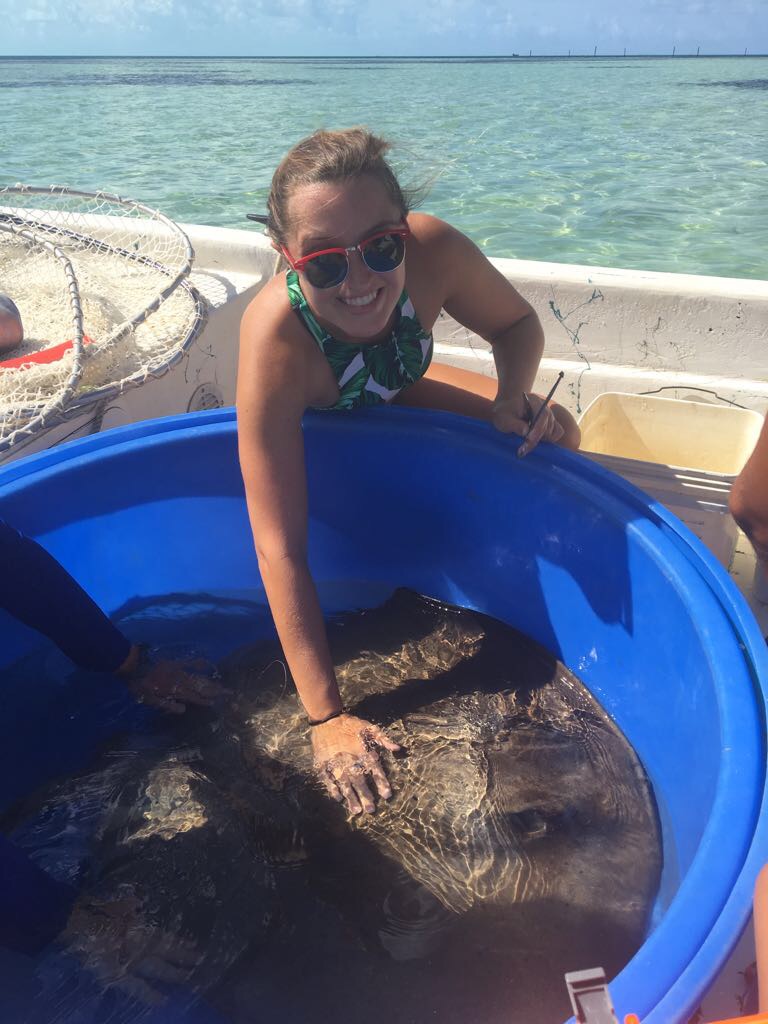
Volunteers Kinsey, Molly, Rebecca and Sophia catching a southern stingray to PIT tag and release.

Friday, 29 September 2017

The Great Sharklab Evacuation - By Rebecca Schijns

The Great Sharklab Evacuation

By Rebecca Schijns

It was the morning of a beautiful and sunny Day Off that we received the ominous news. Gathered at the kitchen table, Lab Manager Ches announced, “Unfortunately, we will be evacuating Bimini… And we have one day to do it.”

Let me explain. This is September in the Caribbean, AKA prime hurricane season. Hurricane Irma had been on our radar for the past week, and we watched anxiously as the projected path aligned directly with Eastern Florida, including our little island of Bimini. The days drew closer and Irma reached Category 5, breaking records as the most powerful recorded storm in the open Atlantic. As much as we all hated to leave our home and all the science we had been working so hard on, we knew it was time to leave.

Standard hurricane preparation consists of an extensive list that is meant to take around three days to complete. However, we had a deadline of 24 hours since the Bimini airport customs decided they would close before our chartered flight (which required stressful reorganization). Volunteers and staff snapped out from their groggy, morning haze into this-means-business mode. Boats were heaved out of the water and tied to surrounding trees. Coconuts were stripped from surrounding palms, unarming the trees of their dangerous ammunition during high winds. All the windows were boarded up and outside paraphernalia was secured inside. Expensive equipment and valuable frozen DNA, isotope, and blood samples were moved to a more secure location. Teams travelled to the field, removing all the precisely placed acoustic receivers. With great remorse, we released eight juvenile lemon sharks from their pens, allowing them to swim to safer waters.  By 10:00pm, the Sharklab crew collapsed on the kitchen floor to eat a much-deserved pizza dinner and share one last evening together for an undetermined amount of time.


The following day we arose early, packed 10lbs of valuables each, and headed to the airport. Flying with four adopted pit bulls proved to be yet another challenge. After exhaustive barking at strangers and a “small” dose of Benadryl, the pups sat, drooling at the window, as we passed over clear blue waters towards Miami. From Miami, the Sharklab crew broke off into smaller groups and headed towards their various destinations across North America.


Caption: Sharklabbers Raquel and Sophia with travel buddies Matthew and Lucifer

Two Weeks Later


After a trifecta of Hurricanes (Irma, Katia, and Jose) passed through the Caribbean, we have returned safely back to our beloved Sharklab! To our shock and relief, the lab remained in one piece through the storm surge. Grateful to be back, we assembled as the new and improved Sharklab crew. While it was strange to wear shoes and have freshwater showers, the short time off the island allowed time to refill on snack supplies and heal from bites and burns. Now, we walk the dock runway in style: flashy new Buff and rash guard, accessorizing with Yeti stickers and Go Pros. Ready to tackle whatever comes our way. Bring on the sharks, Bimini!

Sunday, 16 July 2017

Face to Fin by Sophia Emmons

            The most anticipated activity by any volunteer has got to be the reef shark dive.  It’s one of the few times at the Bimini Biological Field Station that we’re not trying to catch and tag every single shark we can see, just observing their unadulterated beauty.  I consider that day to be one of the most amazing days of my life.

            Upon arrival at Turtle Rocks, all the volunteers jumped into the water wearing fins, snorkel, and a mask and lined up along a line floating parallel to the stern of the boat.  When everyone was in place, a staff member on the boats chummed the water.  Any reef sharks in the area immediately raced over to fill their bellies, causing a feeding frenzy just a few meters in front of our eager faces.  My mother was more than a bit concerned when she saw the footage I took!  After the chum was gone and the frenzy was over, the sharks settled down enough to take a slight curiosity in us.  As we swam around these sentient beings, there was no level of fear in anyone’s faces, just pure adoration for the amazing creatures that could take off a limb in one bite.  But of course, they wouldn’t.  They had their fill of fish and professed no interest in our foreign shapes other than the occasional swim by.  The water was once again calm as we became invasive spectators in the shark’s natural habitat.

            That was my first close encounter with a mature shark in the water.  I had held baby lemons and grabbed the fin of a juvenile tiger shark, but being at eye level with a shark as long as I am tall was a brand-new experience for me.  I saw the white of the sharks’ eyes as they passed by me, sizing me up as I did to him.  As one of them swam by, I could see a hook stuck in its mouth, just like a movie.

            Eventually, the sharks became disinterested in the twelve snorkelers surrounding them.  We became more of a nuisance than a novelty as we shoved underwater cameras in their faces.  We were called back to the boat all too soon, but the smile on my face stayed for the rest of the day!

                                           Caribbean Reef Sharks - Photo by Chelle Blais 

Here is Sophia giving a Southern Stingray a pat on the back after tagging it with a PIT tag!